

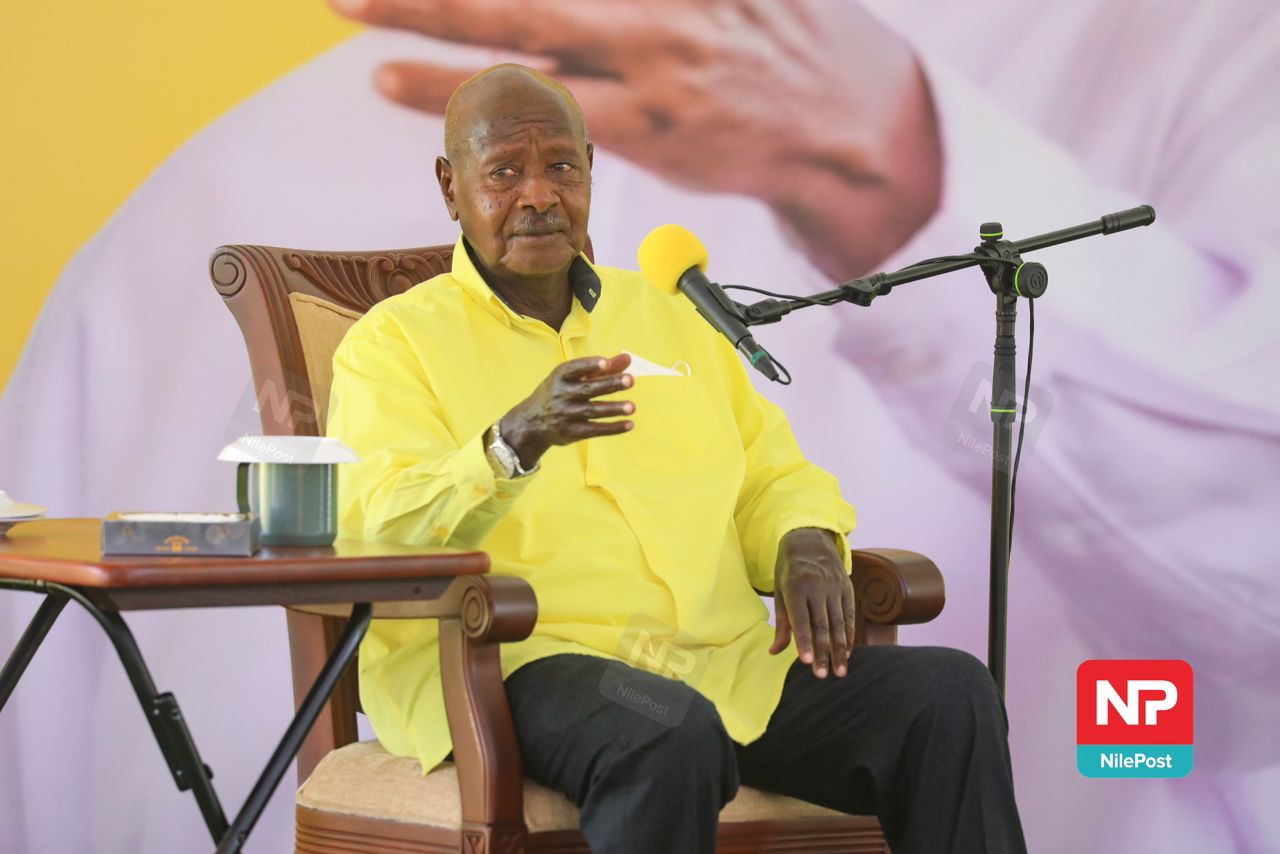
President Museveni’s post-election statement, in which he appeared to mock opposition parties with what he termed a “condolence message” and raised questions about the future of multiparty politics, has triggered sharp reactions across Uganda’s political divide.
In a 10-page statement released on the evening of February 12, 2026, Museveni congratulated his supporters for voting the ruling National Resistance Movement (NRM) back into power in the just-concluded elections.
However, it was the tone of his message — particularly his remarks directed at opposition parties — that stirred controversy.
The President indicated he was sending a “condolence message” to the opposition, whom he defeated at the polls, a remark widely interpreted by critics as mockery rather than magnanimity in victory.
Further into the document, Museveni appeared to question the effectiveness of multiparty democracy, a political system Uganda reinstated following a 2005 national referendum. His comments have since revived debate about his long-held reservations toward competitive party politics.
At the NRM secretariat, party officials defended the President’s remarks, insisting they were directed at what they described as “heartbroken” opposition leaders who had failed to deliver on their campaign promises.
NRM Director of Communication, Emmanuel Dombo, said some opposition figures had been “mourning their loss.”
“Some of them have been mourning their loss. They promised a new Uganda that never came,” Dombo said.
The Chairperson of the NRM Electoral Commission, Tanga Odoi, echoed the sentiment, arguing that voters had rejected what he called unrealistic pledges.
“Some of them made unrealistic promises. The people have rejected that kind of politics,” Odoi said.
NRM leaders further accused the opposition of lacking ideological clarity and resorting to incitement rather than issue-based politics. Dombo suggested that alternative political arrangements, including cooperation agreements, remain an option.
“This can be done through cooperation agreements like we did with Mao,” Dombo said, referring to a previous cooperation arrangement signed with Norbert Mao.
Dr. Odoi went further, questioning Africa’s historical readiness for multiparty systems. “At independence, Africa was not ready for multiparty politics,” he remarked.
The President’s comments have, however, drawn fierce criticism from opposition figures who accuse him of long-standing hostility toward multiparty democracy.
Saddam Gayira, leader of the People’s Progressive Party, described Museveni’s statement as “crocodile tears.”
“He has been persecuting the opposition, and now he faults them. That is hypocrisy,” Gayira said.
Former presidential candidate Kibirige Mayanja, who contested against Museveni during the one-party era, accused the President of never fully embracing multiparty democracy.
“President Museveni has never supported multiparty democracy. He used state machinery to win,” Mayanja said.
Mayanja added that the opposition’s continued participation in Uganda’s political process is evidence of resilience despite what he described as state repression.
“It is proof of resilience on the side of the opposition that, though persecuted, they have kept pushing for what they deserve,” he said.
Political observers warn that any attempt to roll back multiparty democracy could plunge the country into renewed uncertainty, especially after nearly two decades under the current system. Uganda returned to multiparty politics in 2005 after nearly 20 years of the “Movement” system, which restricted political party activity.
While the NRM maintains that the President’s comments were reflective rather than prescriptive, opposition leaders insist that even suggesting a retreat from multiparty politics undermines constitutional order and deepens mistrust in Uganda’s electoral process.
As debate continues, Museveni’s remarks have once again laid bare the ideological fault lines shaping Uganda’s political future, raising fresh questions about the trajectory of democratic governance in the country.
